The wealth palace describes money patterns, not wealth outcomes
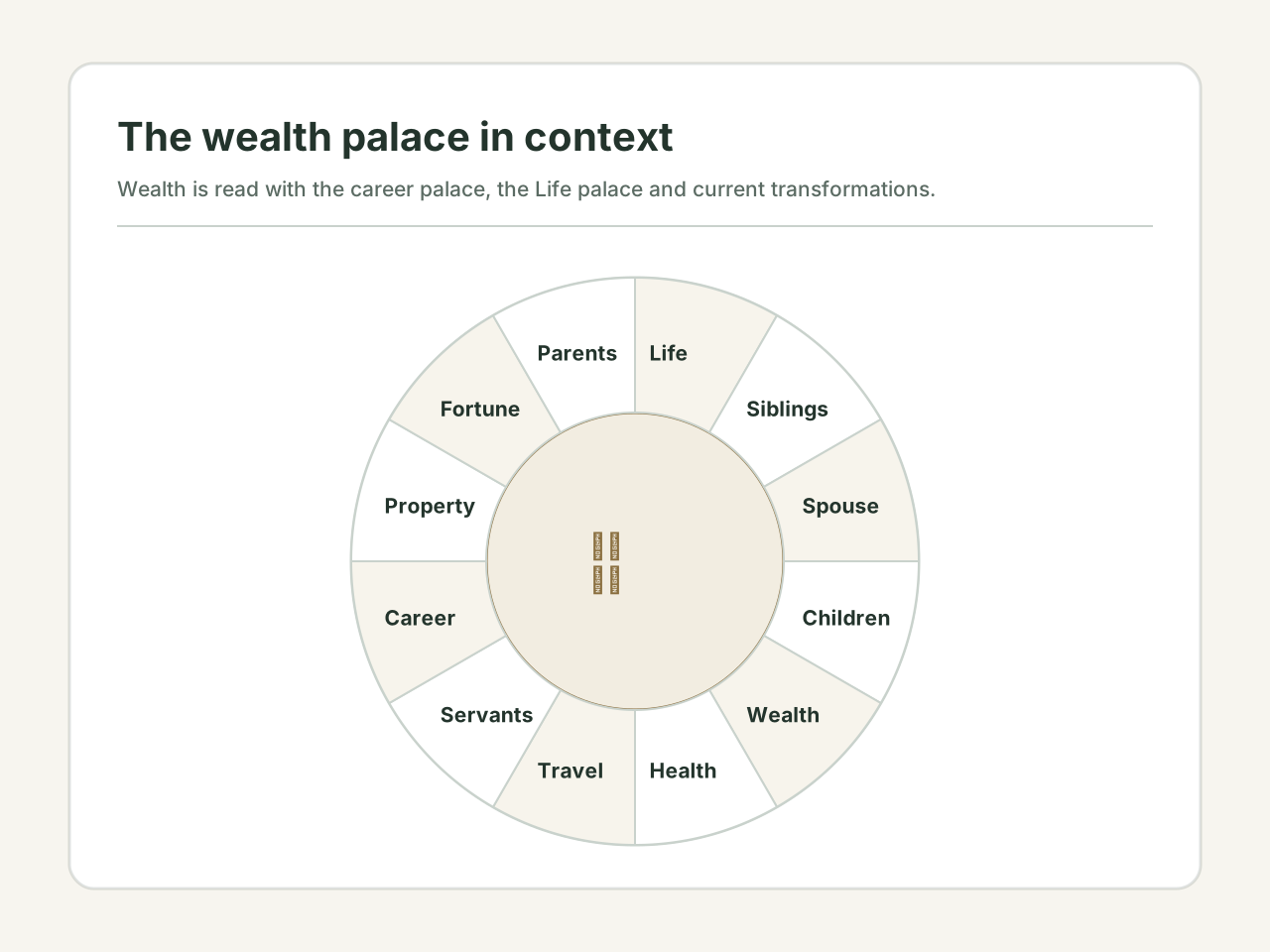
The wealth palace (财帛宫) in Zi Wei Dou Shu describes how money comes into your life, how you handle it, and what your financial tendencies are. It is not a prediction of your net worth. A strong wealth palace is not a promise of wealth, and a weak one is not a promise of poverty. The wealth palace describes the financial pattern — the channel through which money flows — not the amount.
The honest view: the wealth palace is one of the most misunderstood parts of Zi Wei Dou Shu. People want it to tell them how much money they will have. It cannot do that. It can tell you whether money comes through steady employment, entrepreneurial ventures, investments, or other channels. It can tell you whether you are naturally inclined to save or spend, to invest or hoard. These are useful insights for financial planning. But the amount of money you actually have depends on your effort, your opportunities, and your financial decisions.
What the stars in the wealth palace suggest
Here is how the main stars in the wealth palace describe financial patterns:
| Star in wealth palace | Money pattern | Financial strategy | Risk to manage |
|---|---|---|---|
| Wu Qu (武曲) | Wealth through discipline and hard work. Wu Qu is the primary wealth star — it suggests a direct correlation between effort and income | Save systematically, invest in stable assets, build wealth slowly over time. You are suited for careers where income is tied to performance | You may become too focused on money at the expense of other life domains. Financial security is important, but it is not the only form of wealth |
| Tai Yin (太阴) | Wealth through accumulation and management. Tai Yin represents the ability to manage resources and grow wealth steadily | Invest in real estate, long-term assets, and compounding financial instruments. You are suited for wealth management, property, and patient investment | You may be too conservative with money, missing opportunities for growth. Sometimes the safest path is not the best path |
| Tan Lang (贪狼) | Wealth through multiple channels and entrepreneurial activity. Tan Lang represents the ability to spot opportunities and pursue them | Diversify income streams. Do not rely on a single source of income. You are suited for sales, entertainment, hospitality, and any field where income is variable | You may be impulsive with money — spending when you should save, chasing opportunities without due diligence. Build a financial buffer before taking risks |
| Tian Fu (天府) | Wealth through stability and management. Tian Fu is the treasury star — it suggests the ability to accumulate and preserve wealth | Build a diversified portfolio. Focus on preservation as well as growth. You are suited for roles in finance, administration, and asset management | You may be too cautious — hoarding money rather than using it to create more value. Wealth is meant to be used, not just stored |
| Lian Zhen (廉贞) | Wealth through effort and principle. Lian Zhen suggests that money comes through work that aligns with your values | Pursue work that matters to you. Money follows meaning. You are suited for careers where income is tied to purpose — social enterprise, ethical business, mission-driven work | You may undervalue your work or struggle to charge what you are worth. Principle does not mean poverty. You can do good work and be well paid |
The three financial patterns in Zi Wei Dou Shu
Here are the three broad financial patterns the wealth palace describes:
- The earner: the wealth palace contains stars associated with work and effort — Wu Qu, Tai Yang, or the career palace is strong. Money comes through direct effort. The more you work, the more you earn. The financial strategy: maximise your earning capacity through skills and career development. The risk: you cannot work forever. Build passive income streams for the long term.
- The accumulator: the wealth palace contains stars associated with accumulation — Tian Fu, Tai Yin, or the wealth palace is supported by the asset palace. Money comes through saving and investing. The financial strategy: focus on asset accumulation — property, investments, retirement accounts. The risk: you may accumulate without enjoying. Wealth is a tool, not a goal.
- The flow-through: the wealth palace contains stars associated with movement — Tan Lang, Po Jun, or the wealth palace is frequently transformed. Money comes and goes in cycles. The financial strategy: plan for the cycles. Save during the high periods to cover the low periods. The risk: you may spend during the high periods assuming the flow will continue, then struggle when the cycle turns.
A worked example: when the wealth palace says 'spender' but you need to save
A man's wealth palace has Tan Lang (贪狼), the desire star. Tan Lang in the wealth palace suggests a pattern of money coming through multiple channels and a tendency to spend freely. He is a freelance videographer — his income is irregular, and he tends to spend when he has money, then struggle when work is slow.
He reads that Tan Lang in the wealth palace means he is 'destined for financial ups and downs' and resigns himself to the pattern. He assumes the cycle is inevitable and does not try to change it.
A more honest reading: Tan Lang in the wealth palace describes a tendency, not a destiny. The tendency is real — he is naturally drawn to spending and has irregular income. But he can manage the tendency. The solution is not to fight his nature but to structure it. He sets up two bank accounts: one for income and one for spending. When he gets paid, 50% goes into the spending account and 50% goes into a savings account he cannot easily access. He still spends freely from the spending account — the Tan Lang tendency is satisfied. But the savings account grows, and when work is slow, he has a buffer.
Two years later, his income is still irregular, but he has six months of expenses saved. The Tan Lang pattern is still there — he still spends freely from his spending account. But he has added structure that compensates for the tendency. The chart described the tendency; his system managed it.
Where the tradition ends for wealth palace analysis in Zi Wei Dou Shu
The wealth palace in Zi Wei Dou Shu describes your financial tendencies — how money comes, how you handle it, what patterns are likely. But it does not determine your financial outcome. Two people with the same wealth palace can have completely different financial situations depending on their education, their career choices, their spending habits, and their luck. Use the wealth palace to understand your financial tendencies and to design systems that work with them, not against them. The chart is a description of the pattern, not a prediction of the result.
Disclaimer: This content is for informational and cultural reference purposes only. It does not constitute professional medical, legal, financial, or psychological advice. Readers should exercise their own judgment and consult qualified professionals for specific concerns.
Sources and review basis
Traditional references explain historical vocabulary and context. Official practical sources support only the observable safety, comfort, or environmental points noted in the article; they do not validate metaphysical claims.
Traditional reference
Zi Wei Dou Shu Quanshu (紫微斗數全書)Wikisource digital text · Accessed 2026-10-14
A classical source for the twelve palaces, the main stars, and the four transformations that Zi Wei Dou Shu terminology is built on.
Practical source
APA Dictionary of Psychology: Barnum effectAmerican Psychological Association · Accessed 2026-07-14
A psychology reference for why broad, favourable personality descriptions can feel personally accurate. It does not evaluate BaZi calculations themselves.