Commercial taboos are about customer comfort, not cosmic punishment
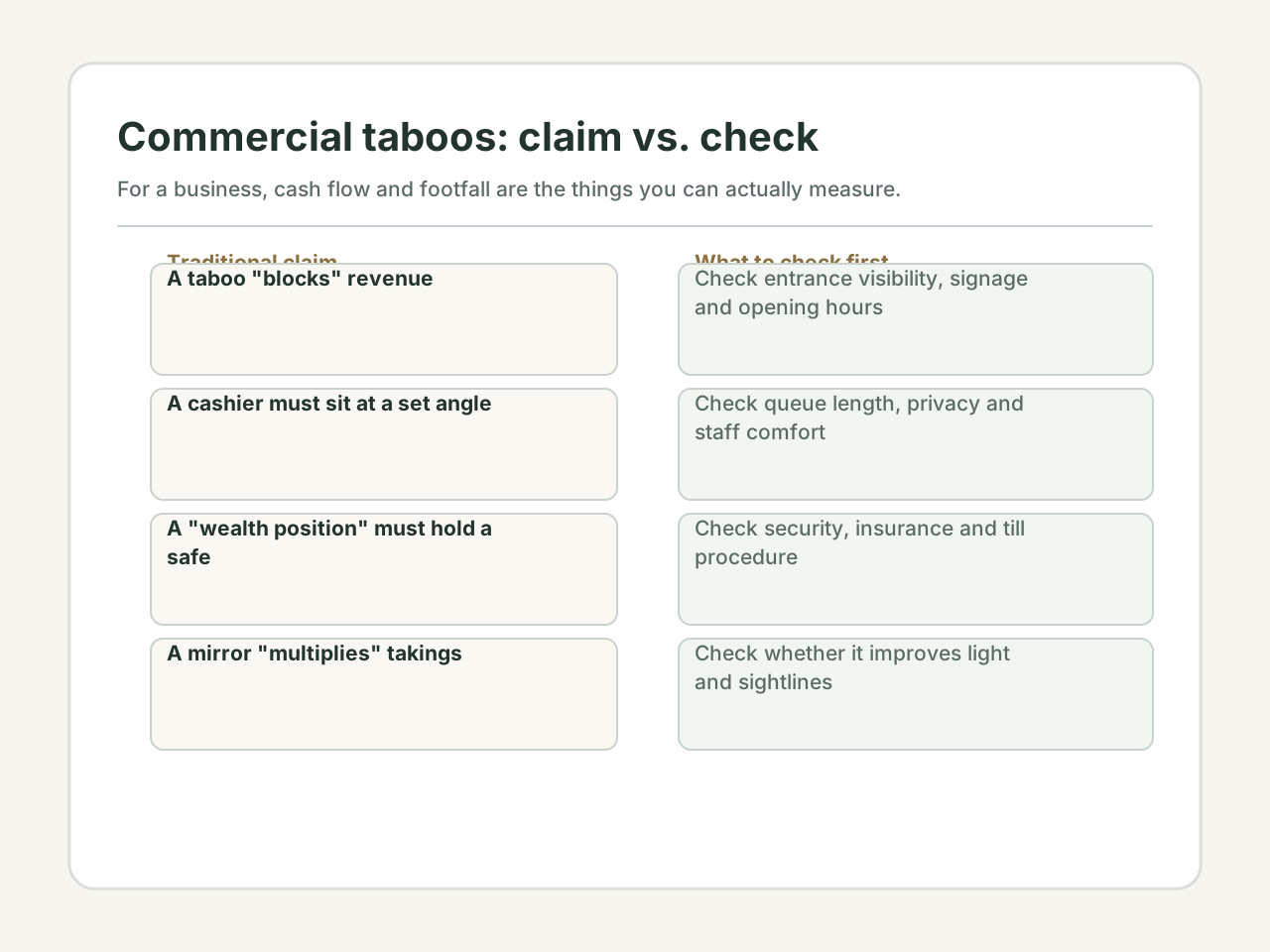
Commercial feng shui taboos are a long list of things you should not do in a business space: do not place the cash register facing the door, do not have a pillar blocking the entrance, do not have a mirror reflecting the cash register, do not have a toilet visible from the main floor, do not have a staircase directly facing the entrance. The implication is that violating these taboos will drive away customers and cause financial loss through some cosmic mechanism.
The honest view: these taboos are not about cosmic punishment. They are about customer psychology. A cash register facing the door makes the cashier feel exposed and the customer feel watched. A pillar blocking the entrance makes the store hard to navigate. A mirror reflecting the cash register is distracting. A visible toilet is unpleasant. A staircase facing the entrance draws the eye upward and away from the merchandise. Each taboo is describing a real, observable problem with the customer experience. The traditional language of 'sha qi' (killing energy) is dramatic, but the underlying issue is simple: something about the space is making customers uncomfortable.
What the common taboos actually mean
Here are the most common commercial feng shui taboos, translated into plain language:
| Taboo | Traditional reason | What it means in practice |
|---|---|---|
| Cash register facing the door | Wealth flows out as fast as it comes in | A cashier staring at the door all day is waiting for customers, not serving them. It creates a dead zone at the entrance. The register should be deeper in the store so customers walk through the merchandise to reach it |
| Pillar blocking the entrance | The pillar creates sha qi that drives customers away | A pillar in front of the door is a physical obstacle. It makes the entrance feel narrow and unwelcoming. Customers may not even register the door as an entrance if it is partially hidden behind a structural column |
| Staircase facing the entrance | Qi rushes up the stairs and bypasses the ground floor | A staircase directly in front of the entrance draws the eye upward. Customers enter and immediately look at the stairs instead of the products on the ground floor. It is a visual distraction, not an energy leak |
| Toilet visible from the main floor | The toilet flushes wealth away | A visible toilet is unpleasant. It smells, it makes noise, and it breaks the visual experience of the store. Customers do not want to shop next to a bathroom |
| Mirror reflecting the cash register | The mirror doubles the outflow of money | A mirror behind or beside the register creates visual confusion. The cashier sees reflections, customers see themselves, and the focus shifts from the transaction to the distraction. The register area should be visually calm |
The taboos worth paying attention to
Not all commercial feng shui taboos are useful. Here are the ones that actually affect customer behaviour:
- The entrance must be obvious and unobstructed. This is the number one rule of retail design, and it happens to be the number one feng shui taboo. If a customer cannot immediately see where to enter, or if the entrance is narrow, dark, or blocked by displays, they will walk past. The entrance should be the brightest, widest, most welcoming part of the storefront.
- The checkout area should be stable and calm. The traditional taboo against mirrors, clutter, and sharp angles around the register is correct: the checkout is where money changes hands, and customers need to feel confident and unhurried. A clean, well-lit counter with a clear view of the transaction is the practical minimum.
- Staff areas should be invisible to customers. The traditional taboo about back-of-house clutter visible from the sales floor is a real problem. Customers do not want to see stacked boxes, cleaning supplies, or staff eating lunch. Keep the boundary between 'front of house' and 'back of house' clear and clean.
A worked example: a restaurant that fixed its entrance
A small Chinese restaurant in a strip mall has been struggling. The food is good, the prices are fair, but the restaurant is half-empty most nights. The owner consults a feng shui master, who immediately points to the entrance: the door is recessed from the street frontage, the signage is small and poorly lit, and a large potted plant partially blocks the doorway. The master diagnoses 'sha qi from the blocked entrance' and prescribes a mirror, a wind chime, and a Pi Yao statue.
The owner skips the Pi Yao and the wind chime. Instead, she removes the plant, installs brighter lighting above the door, replaces the small sign with a larger one, and adds a menu display on a stand outside the entrance so passersby can see what the restaurant serves. She also paints the door frame a warm red to make it more visible from the street.
Result: within a month, foot traffic increases by about 30%. The food did not change. The prices did not change. What changed was that people could now see the restaurant and understand what it offered before committing to enter. The feng shui master was right about the problem — the entrance was the issue — but wrong about the solution. The solution was better visibility, not a wind chime.
What commercial feng shui taboos change, and what they do not
Commercial feng shui taboos are a pre-modern way of describing retail design principles. They are useful as a checklist: is the entrance clear? Is the checkout calm? Is the layout intuitive? Are unpleasant things hidden? But they are not magical laws, and violating them will not cause your business to fail through supernatural means. A business fails because of bad location, bad product, bad service, or bad management — not because the cash register was facing the wrong compass direction. Use the taboos as a customer-experience checklist, not a source of anxiety.
Disclaimer: This content is for informational and cultural reference purposes only. It does not constitute professional medical, legal, financial, or psychological advice. Readers should exercise their own judgment and consult qualified professionals for specific concerns.
Sources and review basis
Traditional references explain historical vocabulary and context. Official practical sources support only the observable safety, comfort, or environmental points noted in the article; they do not validate metaphysical claims.
Traditional reference
Huangdi Zhaijing (黄帝宅经)Wikisource digital text · Accessed 2026-07-14
Historical context for traditional residential orientation and spatial vocabulary. Modern recommendations are reviewed separately.
Practical source
CCOHS: Office ErgonomicsCanadian Centre for Occupational Health and Safety · Accessed 2026-07-14
Practical guidance for workstation setup, posture, reach, lighting, and office comfort.