Mei Hua Yi Shu is a thinking tool, not a fortune-telling machine
Mei Hua Yi Shu (梅花易数), or 'Plum Blossom Numerology', is a classical Chinese divination method attributed to the Song dynasty scholar Shao Yong (邵雍). It uses numbers, dates, sounds, images, or sudden events to form hexagrams from the I Ching (易经), the Book of Changes. The method is fast, flexible, and does not require tossing coins or yarrow stalks — the 'trigger' can be anything: the time you looked at a clock, the number of words in a question, the direction a bird flew.
The honest view: Mei Hua Yi Shu is a structured way to reflect on a situation. It takes a specific question or moment, converts it into a hexagram through a mathematical formula, and then interprets the hexagram's meaning in relation to your question. The value is not in predicting the future — it is in forcing you to look at your situation from a new angle. The hexagram is a mirror, not a crystal ball.
How the method works in plain terms
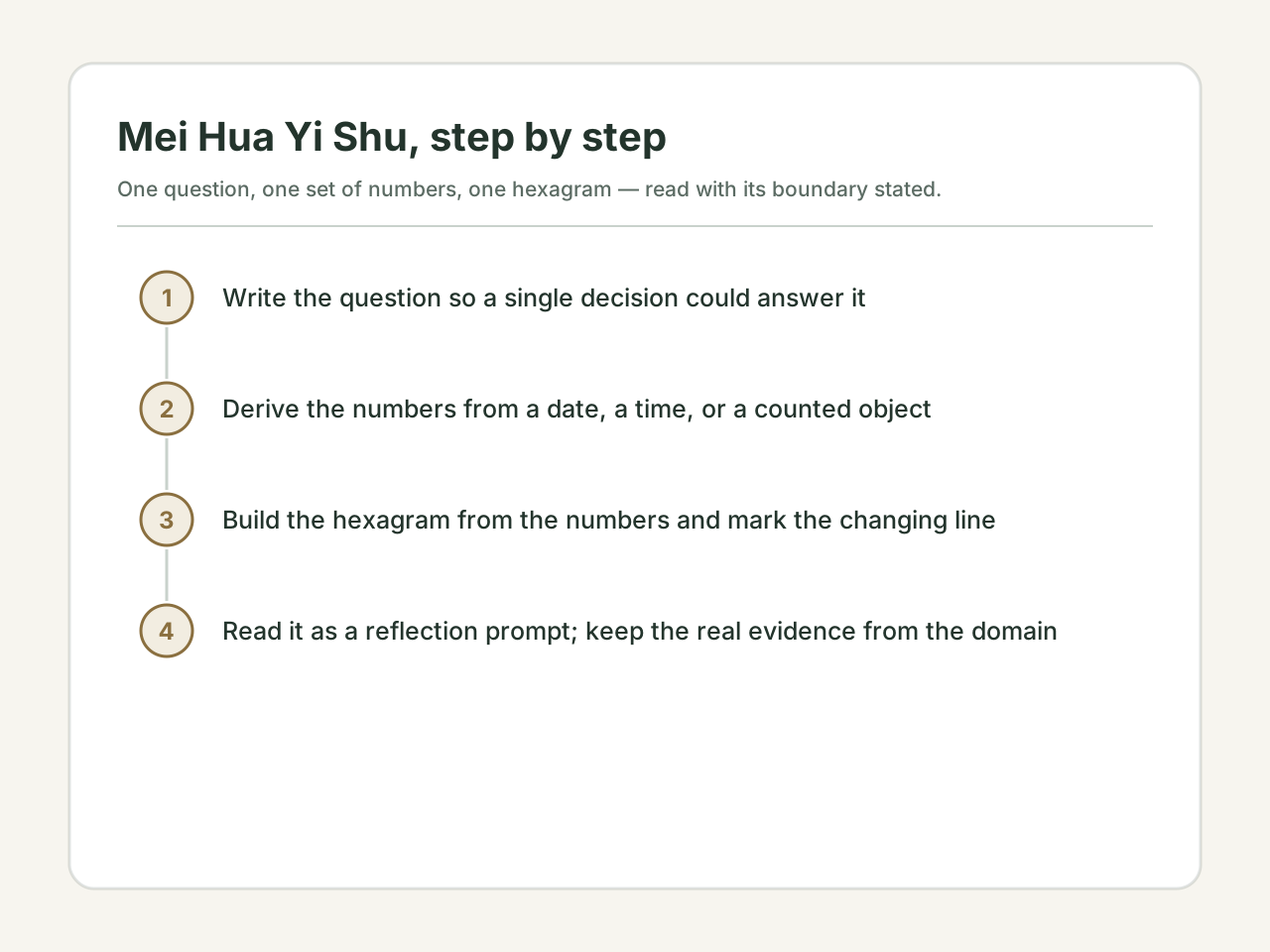
The core of Mei Hua Yi Shu is converting a trigger into two trigrams (upper and lower), which form a hexagram, and then identifying the moving line that creates a second hexagram. Here is the process in plain terms:
| Step | What you do | Example: asking about a job change at 2:34 PM |
|---|---|---|
| 1. Identify the trigger | Choose a time, number, sound, or event that prompted the question | The time: 14:34. Split into upper number (14) and lower number (34) |
| 2. Form the upper trigram | Divide the upper number by 8, use the remainder. Remainder 0 = 8 (Kun) | 14 ÷ 8 = 1 remainder 6. 6 = Kan (坎, Water, ☵) |
| 3. Form the lower trigram | Divide the lower number by 8, use the remainder | 34 ÷ 8 = 4 remainder 2. 2 = Dui (兑, Lake, ☱) |
| 4. Form the hexagram | Upper trigram above, lower trigram below | Kan above Dui = Hexagram 60 (节, Limitation) |
| 5. Find the moving line | Divide the lower number by 6, use the remainder. Remainder 0 = line 6 | 34 ÷ 6 = 5 remainder 4. Line 4 changes |
| 6. Form the transformed hexagram | Change the moving line (yin to yang or yang to yin) in the original hexagram | Hexagram 60 line 4 changes → Hexagram 58 (兑, Joy) |
The right way to use divination
Mei Hua Yi Shu is a tool for reflection, not a substitute for judgment. Here is how to use it productively:
- Ask a specific question. 'Will I be happy?' is too vague. 'Should I accept the job offer from Company A or stay at Company B?' is specific enough to produce a useful reading. The hexagram's meaning becomes a lens through which you examine the decision, not a yes/no answer.
- Read the hexagram as a description of a situation, not a prediction. If the hexagram is 'Limitation' (节), ask yourself: where in this decision am I feeling constrained? What limits am I placing on myself? What limits are reasonable? The hexagram gives you a vocabulary for analysing your situation.
- Do not ask the same question repeatedly. The traditional rule is that the first reading is the relevant one. Asking again because you did not like the first answer turns divination into a search for reassurance, which defeats its purpose as a thinking tool.
- Use the transformed hexagram as a direction, not a destination. The transformed hexagram suggests how the situation might evolve if the energy of the moving line plays out. It is a 'what if' scenario, not a guaranteed outcome.
A worked example: using Mei Hua Yi Shu for a career decision
A woman is deciding whether to leave her stable corporate job to join a startup. She is torn: the startup offers more money and excitement, but less security. She uses Mei Hua Yi Shu to reflect on the decision.
She uses the date as the trigger: May 15. Upper number 5, lower number 15. 5 ÷ 8 = remainder 5, upper trigram = Xun (巽, Wind, ☴). 15 ÷ 8 = remainder 7, lower trigram = Gen (艮, Mountain, ☶). Xun above Gen = Hexagram 53 (渐, Development/Gradual Progress). Moving line: 15 ÷ 6 = remainder 3, line 3 changes. Transformed hexagram: Hexagram 53 line 3 changes → Hexagram 20 (观, Contemplation).
Her reading of Hexagram 53 (Development): 'Gradual progress. The wild goose gradually approaches the dry land.' The hexagram is about slow, steady advancement — not leaps. It suggests that the path forward is incremental, not dramatic. The moving line 3 warns: 'The wild goose gradually approaches the high plateau. The husband goes to battle and does not return. The wife is pregnant but does not give birth. Misfortune.' This is a warning against forcing progress before conditions are right.
The transformed hexagram 20 (Contemplation): 'Observing. The ceremony has been performed, but the offering has not yet been made.' The hexagram suggests a period of watching and waiting before acting. Her reflection: the reading does not tell her 'stay or go'. But it makes her ask questions she had not been asking: Is the startup really a step forward, or is it a leap into instability? Am I leaving because I am progressing, or because I am restless? She decides to stay at her current job for six more months, use the time to build skills and savings, and re-evaluate then. The reading did not make the decision for her. It gave her a framework for thinking about the decision more carefully.
A realistic view of mei hua yi Shu
Mei Hua Yi Shu is a sophisticated system of pattern recognition and symbolic interpretation. It has been used for centuries as a way to structure thinking about difficult decisions. But it is not a science, and it is not a reliable method of predicting the future. The hexagrams are poetry, not data. Their value is in the questions they prompt you to ask, not in the answers they appear to give. Use Mei Hua Yi Shu as a thinking tool — a way to examine a situation from a perspective you would not have considered on your own. Do not use it to outsource your judgment. The hexagram can suggest a direction, but you are the one who has to walk.
Disclaimer: This content is for informational and cultural reference purposes only. It does not constitute professional medical, legal, financial, or psychological advice. Readers should exercise their own judgment and consult qualified professionals for specific concerns.
Sources and review basis
Traditional references explain historical vocabulary and context. Official practical sources support only the observable safety, comfort, or environmental points noted in the article; they do not validate metaphysical claims.
Traditional reference
Mei Hua Yi Shu (梅花易數)Wikisource digital text · Accessed 2026-10-15
The classical text traditionally attributed to Shao Yong that gives the plum blossom method its number-based hexagram derivation. Cited for the method as described, not as a claim that it predicts events.
Traditional reference
Book of Changes (周易)Wikisource digital text · Accessed 2026-10-14
The classical text that writes yang lines as 九 and yin lines as 六, which is where calling the ninth day double yang comes from. Cited for terminology, not for any claim about the date.
Practical source
APA Dictionary of Psychology: Barnum effectAmerican Psychological Association · Accessed 2026-07-14
A psychology reference for why broad, favourable personality descriptions can feel personally accurate. It does not evaluate BaZi calculations themselves.